Outdoor Products:
 |
| Bondi Beach |
Bondi Beach is a popular beach and the name of the surrounding suburb in Sydney, Australia. Bondi Beach is located 7 kilometres east of the Sydney CBD. 'Bondi' or 'Boondi' is an Aboriginal word meaning water breaking over rocks or noise of water breaking over rocks. The Australian Museum records that Bondi means 'place where a flight of nullas took place'.
 |
| Bondi Beach |
In 1809, the road builder William Roberts received a grant of land in the area. In 1851, Edward Smith Hall and Francis O'Brien purchased 200 acres (0.81 km2) of the Bondi area that included most of the beach frontage, which was named the "The Bondi Estate." Hall was O'Brien's father-in-law. Between 1855 and 1877 O'Brien purchased his father-in-law's share of the land, renamed the land the "O'Brien Estate," and made the beach and the surrounding land available to the public as a picnic ground and amusement resort. As the beach became increasingly popular, O'Brien threatened to stop public beach access. However, the Municipal Council believed that the Government needed to intervene to make the beach a public reserve. On 9 June 1882, the Bondi Beach became a public beach.
 |
| Bondi Beach |
The beach is backed by attractive parkland, where you can relax, play games or take a walk. It is also a popular place amongst rollerbladers, skaters and cyclists. There is a fantastic promenade backing the beach, which continues along the coast, around the headland. Heading towards the northern headland you can also see one of Sydney's Aboriginal sites. Within the golf course there are some great Aboriginal rock engravings, giving you an excuse to have a break from the game.
 |
| Bondi Beach |
On 6 February 1938, 5 people drowned and over 250 people were rescued after a series of large waves struck the beach and pulled people back into the sea, a day that became known as "Black Sunday".
Bondi Beach was a working class suburb throughout most of the twentieth century. Following World War II, Bondi Beach and the Eastern Suburbs became home for Jewish migrants from Poland, Russia, Hungary, Czechoslovakia and Germany, while a steady stream of Jewish immigration continues into the 21st century mainly from South Africa, Russia and Israel, and the area has a number of synagogues, a kosher butcher and the Hakoah Club.
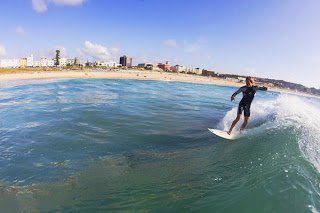 |
| Surfing at Bondi Beach |
There is an underwater shark net shared, during the summer months, with other beaches along the southern part of the coast. Pods of whales and dolphins have been sighted in the bay during the months of migration. Fairy penguins, while uncommon, are sometimes also seen swimming close to shore or amongst surfers in southern line-up.
Readmore..


